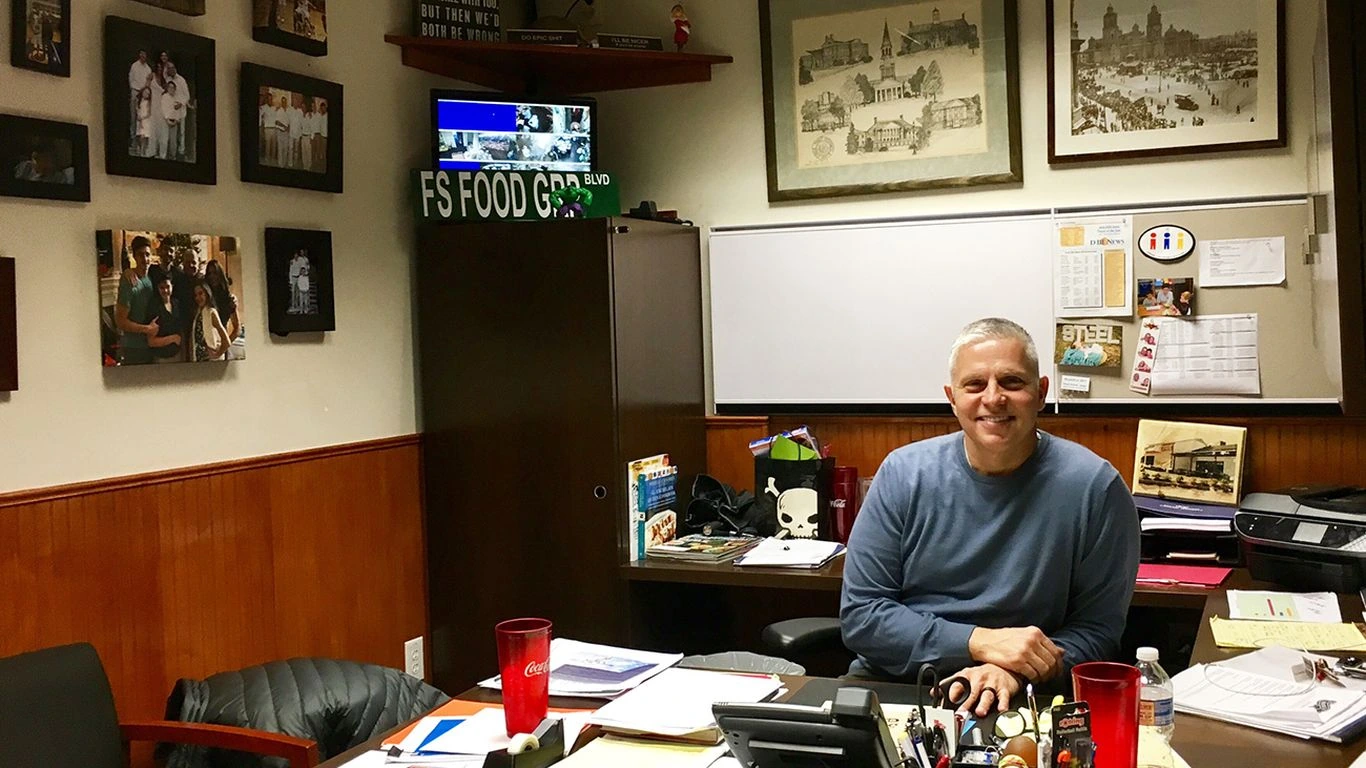
Frank Chivas is a Tampa Bay-area restaurateur and entrepreneur, best known as the President and owner of Baystar Restaurant Group, a multi-concept dining company operating across the Clearwater and broader Tampa Bay region in Florida. Based on available public indicators, his estimated net worth falls somewhere in the range of $5 million to $15 million as of mid-2026, though no verified public disclosure exists to pin it down precisely. That range reflects the scale of a regional multi-restaurant ownership group, his documented community leadership roles, and the general financial profile of independent hospitality entrepreneurs at his level.
Frank Chivas Net Worth: Estimate, Sources, and Breakdown

Marcus Holloway
15 Jun 2026

Which Frank Chivas are we talking about?

This is worth addressing upfront because the name can cause confusion. "Chivas" is most commonly associated with Chivas Regal, the Scotch whisky brand, and there are various minor public figures and private individuals who share similar names. The Frank Chivas relevant to this search is not a celebrity entertainer, professional athlete, or figure from crime history. He is a Florida-based business owner operating primarily in the restaurant and hospitality space.
Sail Life Clearwater's official team page identifies him directly as President and owner of Baystar Restaurant Group, which serves as the parent company for multiple dining establishments in the Tampa Bay area. LinkedIn confirms the same, noting the group is "Led by Frank Chivas.
" He has also appeared in Clearwater civic life, including a Super Boat Presentation referenced in blank" rel="noopener noreferrer">Clearwater city council meeting minutes, and was listed in leadership context by the Chi Chi Rodriguez Youth Foundation as recently as 2015.
So we're dealing with a legitimate regional public figure, just not a household name.
The net worth estimate and how current it is
The most credible estimate for Frank Chivas's net worth as of June 2026 is in the $5 million to $15 million range. This is an informed estimate, not a verified figure. There is no public financial disclosure, SEC filing, or independently audited statement available for a private business owner of this profile. What we can do is reason from observable data: the scale of Baystar Restaurant Group's multi-location Tampa Bay footprint, the costs and typical valuations of independent restaurant groups of that size, his tenure as a regional business leader, and his demonstrated involvement in civic and nonprofit boards, which generally signals a level of financial stability and community standing consistent with that range.
The estimate is current as of mid-2026 but has not been refreshed from a new primary source within the last 12 months. The restaurant industry has continued to face margin pressure post-pandemic, so the upper end of the range should be treated with appropriate skepticism unless new reporting surfaces to support it.
What the evidence actually shows

Let me be transparent about what sources exist and what each one tells us, because the evidentiary picture here is thinner than it would be for a national celebrity.
- Sail Life Clearwater's 'Meet The Team' page: Confirms Frank Chivas as President and owner of Baystar Restaurant Group. This establishes his ownership stake in a multi-restaurant hospitality company, which is the single biggest factor in estimating his net worth.
- Baystar Restaurant Group LinkedIn page: Corroborates the leadership role and gives a sense of the company's professional footprint and market presence in the Tampa Bay area.
- Chi Chi Rodriguez Youth Foundation (July/August 2015 newsletter): Lists Frank Chivas in a board or leadership context. This is a well-regarded Florida nonprofit, and involvement at that level typically correlates with personal wealth in the low-to-mid seven figures.
- Clearwater city council meeting minutes: References Frank Chivas in connection with a Super Boat Presentation. This places him in civic and possibly sponsorship or event-related activity, which suggests business community ties beyond his restaurant operations.
None of these sources give us hard numbers. What they collectively sketch is a picture of a regionally prominent business owner with diversified civic involvement, which is consistent with a net worth in the millions rather than the hundreds of thousands or the hundreds of millions. The absence of national press coverage, major investment disclosures, or franchise-scale expansion reporting keeps the upper estimate grounded.
How he built his wealth: career and business timeline
Frank Chivas's wealth appears to be built almost entirely through restaurant ownership and hospitality entrepreneurship in the Tampa Bay market. Baystar Restaurant Group is the vehicle for that wealth. Running a multi-concept restaurant group in a competitive Florida coastal market requires significant capital investment, operational savvy, and the ability to manage staff, real estate, and supply chains simultaneously. When owners at this level succeed, the value accumulates through the business equity itself, often in combination with real estate ownership (either owning the restaurant buildings outright or accumulating capital from favorable lease structures).
His civic presence, including nonprofit board involvement with the Chi Chi Rodriguez Youth Foundation by at least 2015, suggests he had reached a level of financial and community standing over a decade ago that warranted that kind of engagement. That timeline implies the business was generating meaningful cash flow well before 2015, putting the foundation of his wealth in the early-to-mid 2000s at the latest. The Super Boat reference in Clearwater council minutes adds an interesting layer: powerboat racing and sponsorship activity in Florida's Gulf Coast scene tends to attract high-net-worth local business owners, which is consistent with his profile.
There are no publicly documented major business failures, bankruptcies, or financial controversies associated with Frank Chivas as of this writing. The restaurant industry is notoriously volatile, and any multi-location operator faces risk from economic downturns, pandemics, and rising food and labor costs. The COVID-19 period from 2020 to 2022 was particularly brutal for independent restaurant groups, and it would be reasonable to assume Baystar Restaurant Group experienced revenue disruption during that window. Whether that meaningfully eroded his net worth or he navigated it successfully is not documented in available public sources.
Assets, liabilities, and the big financial factors

For a regional restaurant group owner, the main wealth components typically look like this:
| Asset/Liability Category | Likely Situation for Frank Chivas | Impact on Net Worth |
|---|---|---|
| Business equity in Baystar Restaurant Group | Primary wealth driver; value depends on revenue multiples and number of locations | High positive impact |
| Real estate (owned vs. leased) | Unknown; Florida commercial real estate would be a major asset if owned | Potentially high positive impact |
| Personal property (residence, vehicles, boats) | Clearwater/Tampa Bay area; likely includes recreational watercraft given Super Boat ties | Moderate positive impact |
| Business debt and lines of credit | Standard for restaurant operations; SBA loans, equipment financing common | Moderate negative impact |
| Personal investments (stocks, retirement accounts) | Typical for business owners at this wealth level but not documented | Unknown impact |
| COVID-era liabilities or relief loans | Possible PPP loans or similar; common across the industry 2020-2022 | Potentially small negative impact if still carried |
The single biggest unknown is the valuation of Baystar Restaurant Group itself. Private restaurant groups are typically valued at 3 to 6 times EBITDA (earnings before interest, taxes, depreciation, and amortization) for a sale or acquisition. Without knowing the group's annual earnings, that calculation stays speculative. What we can say is that a successful multi-location regional restaurant group in a high-traffic Florida coastal market commands real value, and ownership of it represents the core of Frank Chivas's financial profile.
Why the estimates vary and how to verify it yourself
Net worth estimates for private business owners are inherently imprecise, and that's especially true when the subject has no national media footprint. The range you'll see quoted in various places ($5 million to $15 million, or sometimes even wider) reflects the fundamental problem: private companies don't file public earnings reports. If you are also trying to estimate Frank Araiza Mc Pancho net worth, you will need to rely on similar public signals and treat any ranges as unverified. What you're left with is inference from business type, scale, and secondary signals.
If you want to verify or update this estimate yourself, here's where to look:
- Florida Division of Corporations (Sunbiz.org): Search for Baystar Restaurant Group and any related LLCs. Florida business filings show registered agents, officers, and sometimes capitalization or annual report data.
- Pinellas County Property Appraiser (pcpao.gov): Search for Frank Chivas or Baystar Restaurant Group to identify any commercial or residential real estate holdings in Clearwater and the surrounding area.
- Federal court records via PACER: Check for any bankruptcy filings, civil suits, or federal judgments under his name or his company's name.
- Local Tampa Bay business press: The Tampa Bay Business Journal and local outlets like TBT or Creative Loafing Tampa occasionally profile regional restaurant owners and sometimes include revenue figures or growth metrics.
- LinkedIn and Baystar's official channels: Company updates, location openings, or closures give indirect signals about business health and growth trajectory.
One honest caveat: you're unlikely to get a precise number through any of these methods unless a business sale, divorce proceeding, or major lawsuit forces financial disclosure into the public record. For private business owners, the best you can usually do is a reasoned range, which is exactly what this estimate represents.
How Frank Chivas fits into the broader Frank and Frankie wealth database
Frank Chivas occupies an interesting niche in a database like this one. Most profiles in this space are entertainers, athletes, or figures from organized crime history with national or international name recognition. Frank Chivas is something different: a regionally prominent private entrepreneur whose wealth is real and documented enough to warrant inclusion, but who operates well below the celebrity wealth tier.
His estimated $5 million to $15 million range puts him comfortably in the same conversation as other business-owner Franks in this database, rather than the high-end entertainer or sports-figure profiles. If you are looking specifically for Frank Chivas net worth, this $5 million to $15 million estimate is the most defensible range reported from available public evidence estimated $5 million to $15 million range.
For context, figures like Frank Chamizo (a world-class wrestler) or Frank Navarro (a professional boxing coach) represent the sports side of this database, where income streams look very different: competition prizes, coaching fees, and sponsorships rather than restaurant equity. Similarly, figures like Frank Araiza and Frank Martinez from the entertainment and music world built wealth through performance and royalties. Frank Chivas's story is more like Frank Artale or Frank Chaparro, where the wealth narrative centers on business ownership and local market dominance rather than national celebrity. That distinction matters when you're reading a net worth figure: a $10 million private business owner is not the same as a $10 million entertainer, and the liquidity, stability, and verification path for each are very different.
The bottom line is that Frank Chivas is a legitimate public figure in the Tampa Bay business community, his wealth is real and rooted in a traceable business, and the $5 million to $15 million estimate is the most defensible range available given public evidence. If you are comparing this figure to others in the Frank Artus net worth category, it helps to separate restaurant-ownership wealth from celebrity-style income and disclosures.
If Baystar Restaurant Group were ever to be sold, acquired, or subject to litigation, the resulting public filings would give a much sharper number. Until then, this is where the honest evidence lands. If you are looking specifically for Frank Martinez net worth, this article explains why credible public numbers are limited and how estimates are built from business evidence.
FAQ
How can someone confirm whether a “Frank Chivas” in search results is the same person as the restaurateur in Tampa Bay?
Look for consistent role identifiers tied to Baystar Restaurant Group, such as “President,” “owner,” or “led by Frank Chivas,” and cross-check the location to Clearwater/Tampa Bay. If the profile mentions unrelated industries (entertainment, sports, or legal/crime topics) or a different state, treat it as a different individual and do not reuse the net worth estimate.
Why is the Frank Chivas net worth range so wide, from $5 million to $15 million?
The range is driven mainly by one unknown, Baystar Restaurant Group’s private business valuation. Without disclosed earnings or audited statements, you cannot reliably convert business performance into a net worth number, so estimates typically reflect plausible valuations for a regional multi-location operator.
What net worth estimate methods could you use if you want to independently sanity-check the number?
A practical approach is to estimate (1) likely EBITDA from industry benchmarks for similar regional restaurant groups, then (2) apply a reasonable private-company valuation multiple (often cited in practice as a few times EBITDA), and finally (3) adjust for known debt and whether the owner likely holds real estate in addition to operating equity. This still produces a range, not a precise figure.
Does owning the restaurant buildings (versus only leasing) materially change the net worth estimate?
Yes. If Baystar or its holding entities own real estate or have long-term favorable lease structures, that usually increases business value and owner equity. If operations rely more heavily on leases without owned property, the wealth is more tied to operating cash flows, and the valuation could be lower than estimates that assume significant asset ownership.
Could public civic or nonprofit involvement mean he is wealthier than the estimate suggests?
It can be a weak signal, because board leadership often correlates with stability, but it is not a direct measure of net worth. Some community leaders are highly compensated managers, some hold minority stakes, and some invest heavily in local philanthropy. So civic roles support credibility of being established, not a specific dollar amount.
What would most likely cause the $5 million to $15 million estimate to change?
A verified business sale, a major recapitalization, a divorce proceeding that forces asset disclosure, or significant litigation that requires public filings would be the fastest way to narrow the number. Also, credible reporting on large expansions or major new financing could shift valuation assumptions.
How does the restaurant industry downturn (like 2020 to 2022) factor into the estimate?
The article notes margin pressure and volatility, but there is no direct documentation of Baystar’s financial results in that window. If the group took on substantial debt or lost locations during a downturn, net worth could have declined. If it maintained liquidity and avoided heavy closures, it could have recovered without large erosion. Without records, you can only treat this as a risk adjustment.
Is it possible his net worth is below $5 million or above $15 million?
Yes, it is possible, but those outcomes are harder to justify with public evidence. Below $5 million would imply a smaller equity position or lower valuation than typical for a multi-concept, multi-location group. Above $15 million would usually require either clear indications of higher profitability, a larger asset base (for example owned property), or other substantial holdings outside the restaurant business.
Does the “Chivas” name create common mistakes in net worth lookups?
It does. “Chivas” is widely associated with the Scotch brand Chivas Regal, and other individuals with similar names may appear in search results. A common error is mixing unrelated people into the same profile. Always tie the individual to Baystar Restaurant Group and the Tampa Bay/Clearwater context before using any net worth claim.
If you want to keep your own estimate updated, what is the best practical trigger to revisit it?
Re-check when there is new, specific information that affects valuation assumptions, such as announced acquisitions or closures, major openings that change the number of locations meaningfully, fundraising or refinancing announcements, or any public records that reveal transactions or asset details. If none appear, the most defensible position is to keep the estimate as a range rather than forcing a new number.