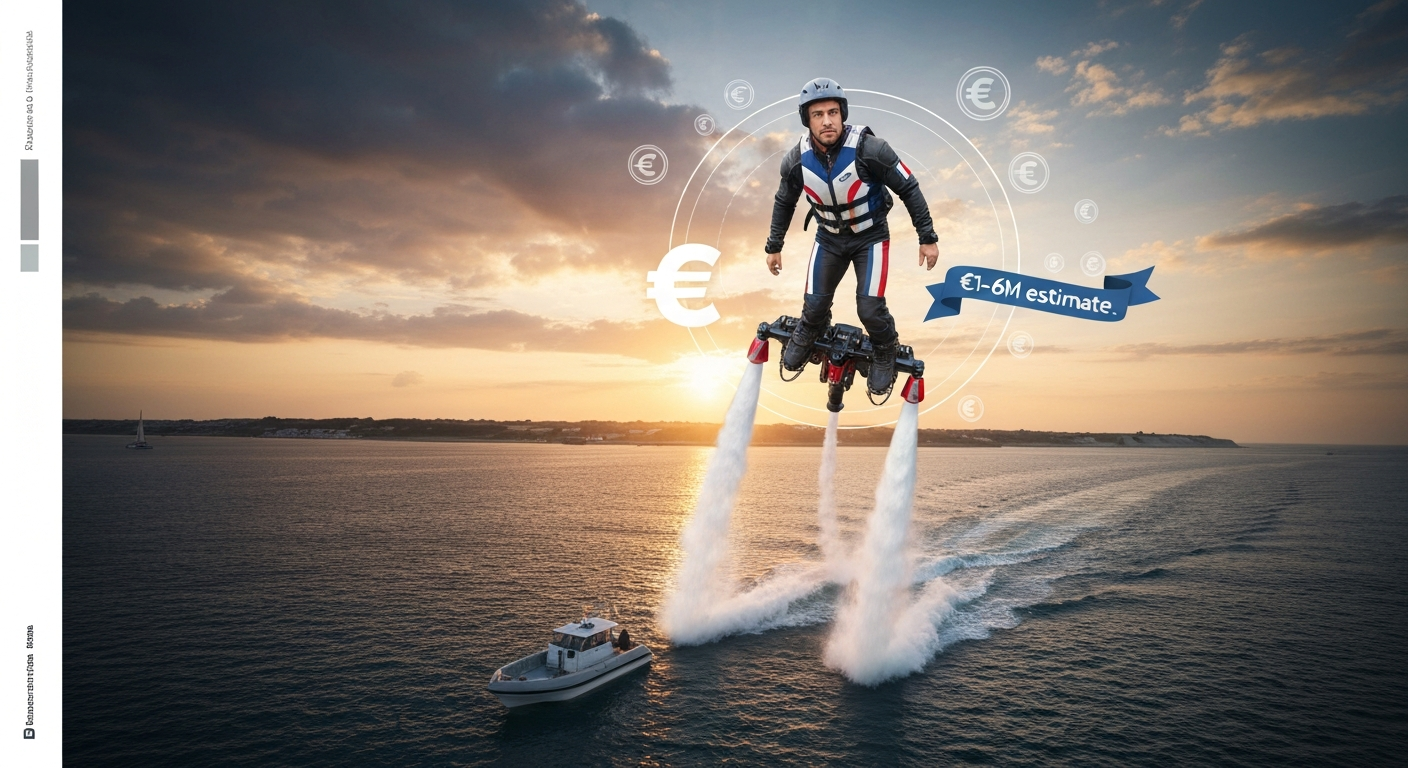
As of August 5, 2026, Franky Zapata's personal net worth is estimated at between €1 million and €6 million. That range reflects conservative owner-equity after accounting for the company reinvestment, manufacturing costs, taxes, legal disputes, and uncertain sale proceeds that separate gross product revenue from what actually landed in the founder's pocket. He is not a billionaire, and the evidence does not support the headline figures sometimes cited in celebrity round-ups, but he has built a genuinely rare and valuable portfolio of intellectual property, brand equity, and government relationships from scratch. For a related profile, see frank quesada net worth in our Frank Net Worth series.
Franky Zapata Net Worth: 2026 Estimate and Financial Breakdown

Marcus Holloway
5 Aug 2026
Net Worth Snapshot
| Detail | Value |
|---|---|
| Estimated personal net worth (low) | €1,000,000 |
| Estimated personal net worth (high) | €6,000,000 |
| Estimate as of | August 5, 2026 |
| Primary currency | Euros (EUR) |
| Confidence level | Low-to-moderate (no audited public accounts available) |
| Primary wealth drivers | IP portfolio, hydro-Flyboard sales, sponsorships, government grants |
| Key uncertainty | No verified shareholder distribution or audited balance sheet in public records |
The €1–6M range is deliberately wide. Public French company registries (Pappers, Infogreffe) show no free-access audited annual accounts for Zapata's registered entities, meaning there is no public balance sheet to anchor a precise figure. Free extracts on Pappers and Infogreffe for ZAPATA FRANCE show no published annual accounts or Kbis PDFs, requiring paid Infogreffe or notary access to obtain full filings Free extracts on Pappers and Infogreffe for ZAPATA FRANCE show no published annual accounts or Kbis PDFs, requiring paid Infogreffe or notary access to obtain full filings.. The estimate is built from the bottom up: reported historical unit sales multiplied by retail price points, with material deductions for costs that any honest analyst must apply. Anyone quoting a single, precise number for Zapata's wealth without those deductions is almost certainly overstating what the founder personally retained.
Quick Facts: Headline Numbers and Income Streams
| Income Stream | Estimated Contribution | Notes |
|---|---|---|
| Hydro-Flyboard consumer product sales | US$39–68M (gross, company-level, historical) | Based on reported >10,000 units × retail range US$3,900–$6,800 per kit |
| Flyboard Air / EZ-Fly (jet-powered units) | Unverified; quoted at ~US$250,000 per unit | Widely reported quoted price; no public sales invoice or audited figure available |
| French military/government development grant | €1.3 million (one-time, 2019) | Confirmed by The Guardian and Zapata company statements |
| Sponsorships and endorsements (e.g., Zenith) | Estimated low-to-mid six figures (EUR) | Zenith 'Friend of the Brand' partnership confirmed by brand press release |
| IP licensing and trademark royalties | Modest ongoing; quantum unverified | FLYBOARD mark registered; ZIPH2O and ZIPAIR hold US patent grants |
| Demonstration and appearance fees | Elevated post-2019; quantum unverified | Bastille Day 2019 and Channel crossing dramatically raised market value |
| 2016 Implant Sciences LOI (potential acquisition) | Up to US$15M cash + equity (announced only) | Implant Sciences entered bankruptcy 2016–2017; completion and proceeds unconfirmed |
Career Timeline: From Jet Ski Champion to Flyboard Inventor
Early Career and the Birth of the Flyboard (Pre-2012)
Franky Zapata was born in 1978 in Marseille, France, and made his name as a competitive jet ski rider before he became an inventor. He was a multiple French and European champion in jet ski freestyle, which gave him two things money cannot easily buy: a deep mechanical intuition for water propulsion systems and an existing audience in the personal watercraft world. His company ZAPATA FRANCE was registered as an entrepreneur-individual (EI) on June 13, 2006, under activity code NAF 90.03B ('Other artistic creation'), which accurately described the performance and demonstration work that would define his early commercial model. That registration remains active today.
Flyboard Launch and Global Licensing (2012–2016)
The hydro-Flyboard, a water-jetpack device powered by a personal watercraft's pump, debuted publicly around 2012 and became an immediate viral sensation. Patent filings began in earnest from 2012 to 2014, with US grants following in 2018 and 2020 (US Patent 10,130,677 and US Patent 10,730,623, both listing Franky Zapata as inventor and ZIPH2O as assignee). Patent database entries on Justia and Google Patents list corporate assignees such as ZIPH2O and ZIPAIR on several Franky Zapata US patent grants and applications, indicating IP-holding entities distinct from retail Zapata Racing operations Justia and Google Patents inventor pages list ZIPH2O and ZIPAIR as assignees for Franky Zapata's US patent filings.. The device was sold through an authorized global reseller network; current retail pricing through CaliforniaFlyboard, an authorized US reseller, shows the Flyboard Pro Series complete kit at US$6,799 and the deck alone at US$3,900. Wired reported that Zapata Racing sold more than 10,000 units historically, which, applied to that retail range, implies gross company-level sales somewhere between US$39 million and US$68 million. That is a compelling revenue story, but it is a company-level gross figure, not a personal windfall, and that distinction matters enormously when building a net worth estimate.
The Implant Sciences Deal and Its Unresolved Outcome (2016)
In 2016, US-listed company Implant Sciences announced a letter of intent to acquire Zapata Industries SAS on terms that included US$15 million in cash plus equity and warrants. On paper, that looked like a transformative liquidity event for Zapata as founder. In practice, Implant Sciences entered bankruptcy proceedings in 2016 and 2017, and no public record confirms that the transaction closed or that founder proceeds were received in full. This is the single biggest source of uncertainty in Zapata's wealth narrative: a deal was announced that could have changed his financial position dramatically, and then the acquirer collapsed. Without audited disclosure or a confirmed closing statement, I treat any proceeds from this transaction as unverified and exclude them from the conservative baseline estimate.
Flyboard Air, Government Interest, and the 2019 Inflection Point
Zapata's pivot from hydro to jet-powered flight with the Flyboard Air opened a new revenue conversation entirely. The device, an autonomous jet-turbine-powered personal flight platform, attracted quoted pricing of approximately US$250,000 per unit according to widely cited secondary reporting, though no public sales invoices or audited unit-sale records exist to confirm realized transactions at that price. What is confirmed: the French military awarded Zapata's company Z-AIR a €1.3 million development grant (reported by The Guardian, August 4, 2019), and the device appeared in the Bastille Day military parade on July 14, 2019, demonstrating clear government interest in the technology as a potential military platform. That grant is a verified cash injection at the company level, and the military relationship represented strategic value well beyond its face amount.
The English Channel Crossing (August 4, 2019)
On August 4, 2019, Zapata successfully crossed the English Channel on a Flyboard Air, covering approximately 35 kilometers from Sangatte, France, to St. Margaret's Bay near Dover, England. A first attempt on July 25 had failed when he fell during a refueling stop on a support boat. The successful crossing on the 110th anniversary of Louis Blériot's first Channel crossing by airplane generated international headlines across Reuters, The Guardian, Euronews, ABC, NPR, and DW. The commercial impact was immediate: Zenith, the Swiss watchmaker, confirmed Zapata as a 'Friend of the Brand' in a formal press release tied to that event. Demonstration fee rates and sponsorship valuations for Zapata would have risen significantly in the aftermath, though the exact fees are not publicly disclosed.
Business Holdings and Intellectual Property
Zapata's commercial empire is organized across several distinct legal entities, each serving a different function in his business model. Understanding the structure helps explain why gross sales figures do not translate directly into personal wealth.
- ZAPATA FRANCE (SIREN 490 538 766): The original entrepreneur-individual registration, active since 2006. Activity code NAF 90.03B. Limited public financial disclosure available in free-access French registry extracts.
- ZIPH2O: The IP-holding vehicle listed as patent assignee on key US hydro-Flyboard patents (US Patent 10,130,677 and US Patent 10,730,623). Holding IP in a separate entity from the retail operation is standard practice but makes it harder to trace licensing income flows to the founder personally.
- ZIPAIR: A second assignee entity appearing in patent filings, likely the IP vehicle for jet-propulsion and aerial devices, distinct from the water-propulsion line.
- Zapata Racing: The consumer-facing brand under which hydro-Flyboards were sold globally through authorized resellers.
- Z-AIR: The entity named in the French military €1.3M development grant, indicating a dedicated corporate vehicle for the advanced Flyboard Air program.
- FLYBOARD trademark: Registered in US trademark databases under ZIPH2O / Zapata-related owner records (Justia Trademarks). This mark underpins licensing and royalty potential across consumer, commercial, and military channels.
The IP portfolio is arguably the most durable asset in Zapata's wealth picture. US patent grants from 2018 to 2020 cover the core propulsion concepts, and the FLYBOARD trademark extends brand protection into licensing. However, patent value is contingent on enforcement, and the litigation history (US federal court docket complaints involving Flyboard and related parties from 2017 to 2018 are on public record) suggests that IP defense has already been a cost center, not just an income source.
Contracts, Sponsorships, and Government Interest
The French military's relationship with Zapata is the most strategically significant external relationship in his financial story. The €1.3 million development grant reported in 2019 is confirmed, but the longer-term question is whether Z-AIR has secured or will secure ongoing procurement contracts for the Flyboard Air as a military platform. No publicly disclosed procurement contract or follow-on military purchase agreement has been confirmed in open-source records as of this writing. The Bastille Day 2019 demonstration was clearly a showcase event, and the military's stated interest is on the public record, but the translation of that interest into recurring contract revenue remains unverified.
On the commercial sponsorship side, the Zenith partnership is the most prominently documented. Zenith's press release explicitly named Zapata as a 'Friend of the Brand' around the Channel crossing, a relationship that typically involves fee payments, product supply, and co-branding rights, though the financial terms of that arrangement are private. Other sponsorships and appearance fees are plausible given Zapata's global profile post-2019 but are not individually documented in public records. The Bastille Day appearance alone would have carried significant value as a national platform, and the implied endorsement of a French government ceremony almost certainly elevated commercial rates.
Real Estate, Investments, and Liabilities
Public records do not reveal specific real estate holdings, investment portfolios, or personal loan balances for Franky Zapata. French property ownership records are not freely accessible in the same way US county assessor records are, and no media reporting or court filings in the public domain have identified specific property assets or personal debts. What the public record does show, indirectly, is a pattern of company-level financial complexity: the Implant Sciences LOI and subsequent bankruptcy, litigation involving Flyboard-related entities, and the operational funding gap that necessitated a €1.3M government grant all suggest that Zapata's enterprises have operated with meaningful financial stress at various points. That context supports a conservative personal net worth estimate rather than an optimistic one.
On the liability side, multi-year R&D programs for jet-propulsion personal flight are extraordinarily capital-intensive. Turbine development, safety certification, insurance for demonstration flights, and legal defense of an IP portfolio across multiple jurisdictions all represent ongoing cash outflows. Without audited accounts, the exact liability picture is unknown, but any realistic net worth estimate for a deep-tech founder in this position has to account for the probability that company-level debt obligations exist and may partially encumber the founder's equity position.
Achievements and Events That Moved the Wealth Needle
- Flyboard invention and commercial launch (2012): Created the foundational product category and IP estate that underpins all subsequent valuation. The reported 10,000-plus units sold at US$3,900–$6,800 per kit represent the single largest revenue source in the company's history.
- US patent grants (2018–2020): US Patent 10,130,677 and US Patent 10,730,623 granted to inventor Franky Zapata with ZIPH2O as assignee, formalizing IP protection and creating the basis for licensing and enforcement.
- Implant Sciences LOI (2016): A potential US$15M cash acquisition was announced. The acquirer's bankruptcy made the outcome uncertain, but the announcement itself established a market valuation benchmark for the company's technology.
- Bastille Day demonstration (July 14, 2019): Zapata flew a Flyboard Air over the Paris military parade in front of the French president and international media. The event confirmed French government endorsement and massively elevated brand value and demonstration fees.
- French military €1.3M development grant (2019): A verified cash injection and the clearest public signal of institutional military interest in the platform as a defense technology.
- English Channel crossing (August 4, 2019): The most globally visible event in Zapata's career, generating international coverage and directly triggering the Zenith sponsorship and likely significant increases in appearance and demonstration fees.
- FLYBOARD trademark registration: Secured brand protection that underpins global licensing potential beyond direct product sales.
- Litigation history (2017–2018): US federal court complaints involving Flyboard-related parties represent both a validation of IP worth defending and a material cost to the company's cash position.
How This Estimate Was Built
The Methodology, Step by Step
The estimate starts with the most concrete data point available: Wired's reported claim that Zapata Racing sold more than 10,000 hydro-Flyboard units. Applying the current authorized US retail price range (US$3,900 for the deck to US$6,800 for the complete kit, from CaliforniaFlyboard product pages as of August 2026) to that unit count gives a gross company-level revenue band of approximately US$39 million to US$68 million across the product's commercial lifetime. That is the ceiling of the revenue story, not the personal wealth figure.
From that gross, a realistic analyst must deduct: manufacturing and materials costs (personal watercraft accessories are hardware-intensive, with typical margins in the 30–50% gross margin range for a direct-to-consumer hardware brand at best); distributor and reseller margins (Zapata sold through a global authorized reseller network, meaning retail prices are not wholesale prices); multi-year R&D expenditure across both hydro and jet product lines; corporate taxes across French and potentially other jurisdictions; legal defense costs for IP litigation documented in US federal dockets; and any residual company debt obligations. After those deductions, the fraction of gross sales that could have reached the founder as personal liquid wealth is substantially smaller, and conservatively modeled at the €1–6M range given the absence of any audited public disclosure showing otherwise.
The €1.3M French military grant adds a verified cash input at the company level. The Zenith sponsorship and other endorsement fees add a modest but real income stream. The Flyboard Air quoted price of ~US$250,000 per unit, if any units were sold to governments or private buyers at that price, would add meaningfully to the picture, but no public sales records confirm this. The Implant Sciences acquisition, had it completed at its announced terms, would have been the single most transformative event for Zapata's personal wealth; since its completion is unverified and the acquirer went bankrupt, it is excluded from the base estimate.
Uncertainty, Assumptions, and What Could Change This Estimate
The most important caveat here is structural: French private company accounts for Zapata's entities are not accessible in free public extracts from Pappers or Infogreffe. That means this estimate is built on inferred revenue (from sales claims and retail prices), reported grants and sponsorships, and disclosed patent records, not on an audited balance sheet. The true figure could be higher if, for example, military procurement contracts exist and are undisclosed, or if the Implant Sciences transaction partially closed with proceeds we cannot see. It could be lower if company-level debt obligations are material or if significant equity was diluted or transferred in undisclosed transactions. The €1–6M range is honest precisely because it acknowledges that spread rather than pretending a false precision.
This estimate is reproducible: anyone starting from the Wired sales claim, the CaliforniaFlyboard retail prices, The Guardian's grant reporting, and the Zenith press release, then applying conservative hardware-business margin assumptions and excluding the unverified Implant Sciences proceeds, will arrive at a similar range. If Zapata or his company ever publish audited accounts or if a verified military procurement contract is disclosed, the estimate should be revised upward.
How Zapata Compares to Other Frank and Frankie Profiles
Franky Zapata occupies an unusual corner of the Frank Net Worth universe. Most figures on this site built wealth through entertainment, finance, or organized crime, but Zapata is fundamentally a deep-tech inventor-entrepreneur whose net worth is anchored in patents and physical product sales rather than performance royalties or deal fees. That makes him more comparable, conceptually, to a tech founder than to a musician or athlete. His estimated €1–6M range is more modest than some might expect given his global profile, but it reflects the reality that hardware businesses with significant R&D burn rates rarely produce the same personal liquidity as a hit record or a successful fund. For a direct comparison, see our Frankie Quiroz net worth profile.
Readers interested in how other Frankies have navigated wealth through performance and entertainment will find contrasting stories elsewhere on this site. For a contrasting entertainment-era example, see the Frankie Negrón net worth profile. The profiles of Frankie Quinones, Frankie Negrón, and Frankie Quiroz trace wealth through entertainment careers where income streams are more directly traceable to public performance records and contract disclosures. On the finance side, the Frank Quattrone profile examines a Wall Street dealmaker whose wealth trajectory was shaped by very different forces: investment banking fees and legal battles. And for readers curious about Frankies whose finances are harder to document than Zapata's, the Frankie Zulferino and Frank Quesada profiles wrestle with similar sourcing challenges. What ties all of these profiles together is the same editorial commitment: document what is verifiable, explain what is estimated, and be transparent about the gap between the two.
Key Takeaways
- Franky Zapata's personal net worth is estimated at €1–6 million as of August 5, 2026, based on inferred owner equity from reported product sales, verified grants, and documented sponsorships, after applying conservative deductions for costs and unverified events.
- The hydro-Flyboard product line, with reported sales of more than 10,000 units at US$3,900–$6,800 per kit, represents the largest cumulative revenue source, but gross sales figures significantly overstate personal wealth once costs, taxes, and distributions are modeled.
- The 2016 Implant Sciences LOI (US$15M cash + equity) is the single largest unresolved variable in his wealth story. The acquirer's subsequent bankruptcy means completion and proceeds remain unverified and are excluded from the conservative baseline.
- The French military €1.3M development grant (2019) and the Zenith sponsorship are the most clearly documented cash-equivalent injections outside of product sales.
- Zapata's IP estate, including US patents held through ZIPH2O and ZIPAIR and the registered FLYBOARD trademark, represents durable asset value that is difficult to quantify without licensing revenue disclosure but should not be ignored in any long-term wealth assessment.
- No audited public accounts exist in accessible French company registries for Zapata's entities, which is the primary reason this estimate carries a low-to-moderate confidence rating. Any revision to a higher or lower figure requires either public disclosure or paid access to private filings.
- For fans, journalists, and researchers: treat any single-number Zapata net worth claim without a methodology as unreliable. The range matters, and the uncertainty is the honest answer.
FAQ
What is Franky Zapata’s estimated net worth (range and date)?
Estimated personal net worth: €1.0–€6.0 million (range), as of 2026-08-05. This is a conservative owner-equity estimate based on public reporting of historical product sales, documented grants/sponsorships, patent holdings, and the absence of audited company financial statements showing large founder distributions or liquidation proceeds.
How was this net worth estimate calculated (methodology)?
Methodology (reproducible): 1) Compile public data: Wired’s reporting that Zapata sold “more than 10,000” hydro-Flyboard units; retail prices from authorized resellers (CaliforniaFlyboard: US$3,900–US$6,799 per kit); public grants (French €1.3M development grant) and documented sponsorships (e.g., Zenith). 2) Compute a gross consumer-sales band: >10,000 units × retail-range → approximate historical gross product revenue ~US$39–68M. 3) Apply conservative adjustments: subtract multi-year manufacturing costs, distributor margins, R&D and operating losses, taxes, legal costs, reinvestment, and possible minority founder ownership or partial exits (no public audited evidence of large founder payouts). 4) Factor in documented non‑product receipts (grants, sponsorships) and patent/IP value, but treat unverified quoted prices for Flyboard Air (~US$250k) as indicative rather than realized revenue. 5) Set final personal net-worth band (after plausible corporate drains and uncertainty) to €1–6M. Sources used and calculation steps: Wired (sales claim), CaliforniaFlyboard (retail prices), patent records (Justia/USPTO), Guardian (grant), Implant Sciences LOI/bankruptcy notices (bankrupt.com) and French corporate extracts (Pappers/Infogreffe).
What are the main income sources that contributed to Zapata’s wealth?
Primary income sources documented in public records and reporting: - Consumer hydro-Flyboard kit sales (company retail/distributor sales). - Demonstration/appearance fees and sponsorships (e.g., Zenith; Bastille Day, Channel-crossing publicity). - Government development funding (French €1.3M grant reported). - Licensing, trademarks and patents (FLYBOARD registrations; multiple patents listing Franky Zapata as inventor/assignee). - Potential commercial/government contracts for R&D or demonstrations (military interest documented). Note: large one-off corporate sale proceeds are not verifiably documented in open-source audited filings; an LOI with Implant Sciences (2016) introduced uncertainty because the acquirer later entered bankruptcy.
What assets are publicly verifiable as belonging to Zapata or his related companies?
Publicly verifiable assets (by filing/registry/patent databases and press): - Patents/IP: multiple US patents and applications listing Franky Zapata (e.g., US Patent 10,130,677; 10,730,623) and assignee names such as ZIPH2O/ZIPAIR (Justia/USPTO/Google Patents). - Trademarks: FLYBOARD trademark records linked to Zapata-related owners (Justia trademark index). - Company registrations: ZAPATA FRANCE (SIREN 490 538 766) and other Zapata-related corporate names visible in French registries (Pappers/data.gouv). - Publicly reported cash grants/sponsorships (e.g., French €1.3M grant; Zenith press release describing brand relationship). What is not publicly verifiable: audited company balance sheets, founder personal bank account balances, or detailed real-estate/investment portfolios without paid registry access or private disclosures.
What liabilities or financial risks are documented that affect net worth?
Documented liabilities/risks include: - Company-level legal disputes and litigation dockets (US federal court filings 2017–2018). - Corporate operational stress and funding shortfalls reported in press (R&D expenses, sales challenges for Flyboard Air). - The uncertainty around the 2016 Implant Sciences LOI and Implant Sciences’ subsequent bankruptcy, which cast doubt on any realized sale proceeds. - Lack of published audited accounts in public French extracts (Pappers/Infogreffe) preventing verification of debt levels or founder compensation. These reduce confidence in high-end net-worth scenarios.
Which milestones and events materially affected Zapata’s wealth trajectory?
Key documented milestones with financial impact: - Invention and commercialization of the hydro-Flyboard (mid‑2000s onward): primary revenue generator via consumer kit sales. - Reported sale volume milestone: Wired’s claim of “more than 10,000” Flyboards sold (company-level cumulative revenue driver). - 2016 LOI announced with Implant Sciences (claimed terms included cash/warrants) — outcome uncertain due to buyer bankruptcy. - French government development grant (reported €1.3M) supporting Flyboard Air development. - High-profile demonstrations: Bastille Day 2019 military parade flyover and successful English Channel crossing (4 Aug 2019) — elevated sponsorship, publicity and potential contract interest. - Patent grants and trademark registrations supporting licensing/royalty potential.