
At his death on July 1, 1928, Frankie Yale's officially declared estate was somewhere between $3,000 and $5,000 in contemporary dollars, roughly $58,000 to $97,000 adjusted to July 2026 purchasing power. That figure, drawn directly from probate filings and contemporaneous press, almost certainly understates what Yale actually controlled during his peak years. His real wealth flowed through cash-heavy rackets, front businesses, and hidden arrangements that were never going to show up in a Brooklyn Surrogate's Court petition.
Frankie Yale Net Worth: Estimated Wealth, Sources & Timeline

Marcus Holloway
13 Aug 2026
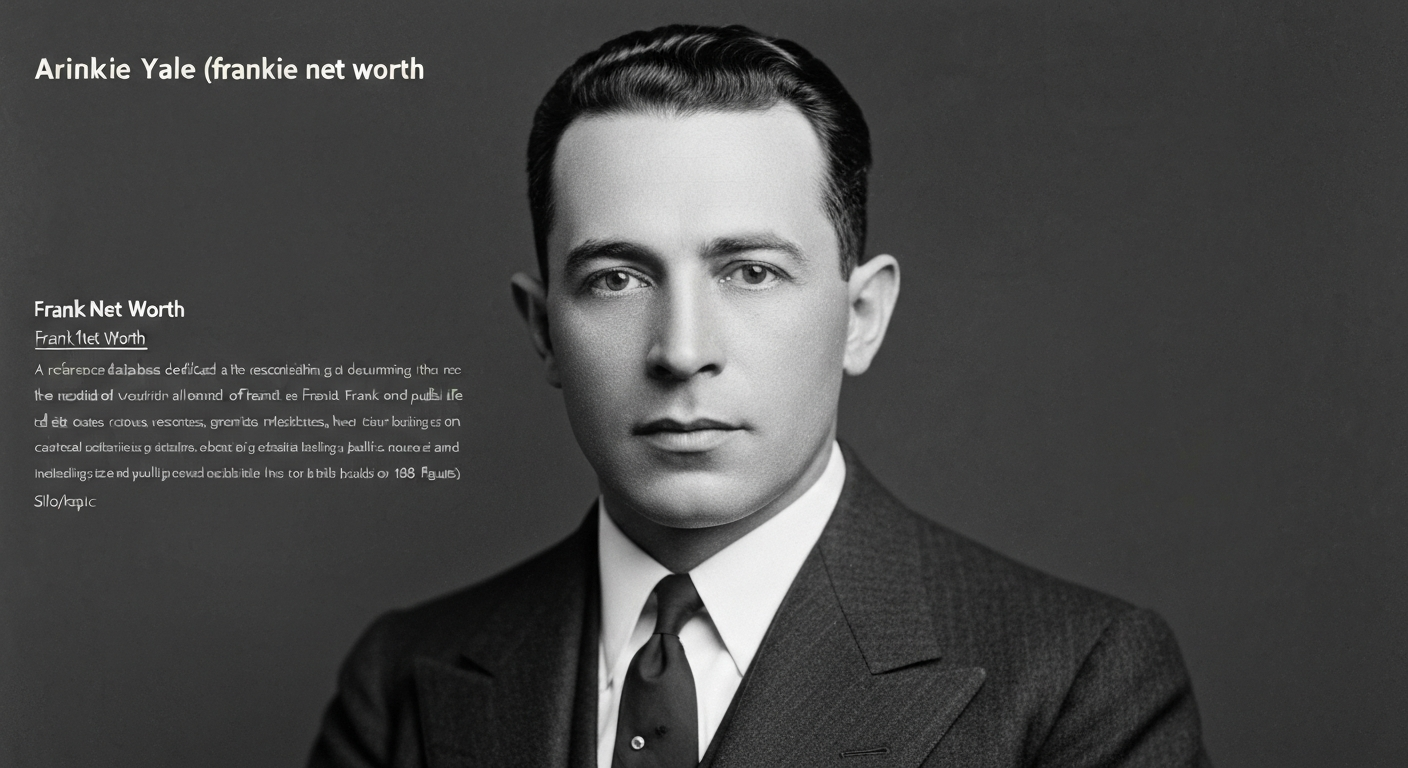
Net worth snapshot
The only hard documentary anchor we have is the probate record. On July 7, 1928, Yale's widow Mary Uale petitioned the Surrogate's Court in Brooklyn to be named executrix of her husband's estate. Her filing declared personal holdings of $5,000 with no real estate listed. The Surrogate's notice transcription (1928 Courts..Bklyn, 'Contest Forecast Over Uale Estate' (Surrogate's notice transcribed)) records Mary Uale's July 7, 1928 petition listing $5,000 in personal property and no real estate 1928 Courts..Bklyn — 'Contest Forecast Over Uale Estate' (Surrogate's notice transcribed). A later United Press wire summary from October 22, 1930 described the gross estate as 'less than $5,000,' and some New York press accounting cited in subsequent crime histories put the final settled figure at approximately $3,000. All three figures are contemporaneous, all three point to the same basic reality: what was legally declared was almost nothing.
| Metric | Contemporaneous value | July 2026 equivalent | Source / confidence |
|---|---|---|---|
| Declared estate (petition, July 1928) | $5,000 | ~$97,065 | Brooklyn Surrogate's Court filing, July 7, 1928 — high confidence |
| Final settled estate (press/probate summary) | ~$3,000 | ~$58,239 | New York press, Oct. 15, 1930 / UP wire Oct. 22, 1930 — moderate confidence |
| Funeral expenditure (reported) | $50,000 claimed; $15,000 silver coffin cited | ~$970,000+ claimed | New York Evening Post / contemporaneous press, July 1928 — reported figure, unverified |
| Estimated peak operational wealth (reconstructed) | $500,000–$1,000,000+ | ~$9.7M–$19.4M | Analyst reconstruction from known rackets — low confidence, see methodology section |
The inflation conversion uses BLS CPI-U data: the 1928 annual average index stood at roughly 17.2 (1982–84 = 100), while the July 2026 CPI-U reads 333.918. That ratio of approximately 19.41 applied to $5,000 yields roughly $97,065, and applied to $3,000 yields roughly $58,239. These are floor figures, not ceilings. The peak operational estimate is a reconstruction based on known revenue streams described below and carries significant uncertainty.
Who was Frankie Yale
Frankie Yale was born Francesco Ioele (also spelled Uale in many records) around 1893 in Calabria, southern Italy, and immigrated to the United States as a child, settling with his family in Brooklyn. Census records from 1910 and 1920 place him in the Bath Beach and 14th Avenue neighborhoods of Brooklyn, occupations shifting from an early listing of 'railroad guard' to 'undertaker' by the early 1920s. That occupation shift is itself a story: the funeral home was a legitimate front, a business that generated steady cash, maintained community respect, and provided a plausible explanation for income. He died on July 1, 1928, shot through the open window of his car while driving on 44th Street in Brooklyn. His death certificate was filed with the Borough of Brooklyn, City of New York, as No. 14764, dated July 3, 1928.
Yale rose through the ranks of Brooklyn organized crime in the early twentieth century, operating during a period before the formal consolidation of the American Mafia. He ran the Harvard Inn, a bar and dance hall on Coney Island that became one of his most publicly associated enterprises. He was a central figure in bootlegging operations during Prohibition, a key ally and occasional rival of Al Capone (who famously worked as a bouncer at the Harvard Inn as a teenager under Yale's employ), and the head of a criminal organization in Brooklyn that extorted the local ice, beer, and coal distribution trades. He was also linked to the Unione Siciliana, a fraternal organization that served as both a community institution and a vehicle for organized crime influence.
How Yale built his fortune
Yale's wealth-building was layered. On the surface, he was a small Brooklyn businessman: a funeral parlor operator, a cigar brand holder, reportedly involved in laundries and a taxi operation. Underneath, he ran protection and extortion rackets, controlled bootlegging supply chains, and collected tribute from legitimate businesses operating in neighborhoods where his organization held sway. The Harvard Inn was an early anchor, generating direct revenue from alcohol, entertainment, and the social capital that came with running a visible Coney Island venue. But the Inn was ultimately a small piece of a larger portfolio of coercion.
During Prohibition, Yale's position as a supplier of bootleg liquor to operations including Capone's Chicago network was likely his highest-revenue period. He acted as a receiver and distributor for hijacked whiskey shipments and reportedly controlled supply routes into Brooklyn. The relationship with Capone eventually soured, and historians widely believe Capone ordered Yale's 1928 assassination in part because Yale was hijacking Capone's own liquor shipments. That context matters financially: Yale was operating at a scale that attracted violent competition from the most powerful criminal organization in the country.
Primary income sources and known assets
- Harvard Inn (Coney Island): bar and dance hall; generated direct alcohol, cover charge, and entertainment revenue; also a venue for Yale's public visibility and recruitment
- Funeral home (Uliano & Yale / Bath Beach area): legitimate front business providing community cover and a source of steady cash income; listed as Yale's occupation in census records and city directories
- Frankie Yale cigar brand: a branded consumer product using Yale's name; the commercial scale was likely modest but it maintained a legitimate business presence
- Laundry and taxi operations: reported in contemporaneous and collector-history sources as additional front businesses; specific revenue figures are not documented in surviving public records
- Bootlegging and liquor distribution: the highest-volume income source during Prohibition; Yale controlled supply and collected from distributors operating in Brooklyn
- Extortion and protection rackets: systematic collection from local ice, coal, and beer distribution trades, a documented feature of his Brooklyn operation
- Unione Siciliana leadership: Yale served as president of the national Unione Siciliana; the position carried influence and likely facilitated tribute collection across affiliated networks
No real estate was listed in the Surrogate's Court filing, which is itself a significant data point. Either Yale did not hold property in his own name (common for gangsters of the era who used proxies or held assets through wives and relatives), or his real estate holdings had been transferred or spent before his death. The funeral home business was almost certainly held through some form of partnership or front arrangement. The probate record reflects only what Mary Uale was willing to declare under oath, not necessarily the full picture of what the family controlled.
Expenditures, seizures, and documented losses
Yale's most spectacular documented expenditure was his own funeral. Contemporary press, including the New York Evening Post and other New York papers, reported a silver coffin valued at approximately $15,000 and described the overall burial as a '$50,000' event. An estimated 10,000 to 15,000 onlookers reportedly lined the streets. Adjusted to July 2026 dollars, a $15,000 expenditure in 1928 represents roughly $291,000 today, and the claimed $50,000 total would represent close to $970,000. Whether those figures are accurate or press-inflated sensationalism is genuinely unclear, but they illustrate why the $3,000–$5,000 probate declaration looks so implausible on its surface.
Beyond the funeral spectacle, Yale operated in a world of high operational costs. Running protection rackets, maintaining armed associates, bribing police and politicians, and managing a bootlegging distribution network all consumed cash continuously. Contemporary syndicated commentary from the era noted explicitly that gangster fortunes were typically cash-based, rapidly spent, hidden through proxies, or simply consumed by the cost of doing criminal business. A United Press piece from October 22, 1930 made exactly this observation in reviewing the estates of several deceased racketeers, noting the mismatch between public impressions of gang wealth and the low values appearing in probate courts. Yale's estate fits that pattern precisely.
There are no documented government seizures of Yale's assets prior to his death in the surviving public record I have been able to identify. Unlike later-era organized crime prosecutions, the legal apparatus for asset forfeiture in the 1920s was limited. The primary financial 'loss event' was his assassination itself, which cut short whatever income streams he was managing and triggered whatever asset dissipation happened in the months between his July 1928 death and the probate filings.
Timeline of key events affecting Yale's fortune
| Date | Event | Financial significance |
|---|---|---|
| c. 1909–1912 | Yale begins working in and around Brooklyn criminal networks; early employment at saloons and Coney Island venues | Entry-level earning; no documented assets |
| c. 1917–1918 | Harvard Inn operation fully associated with Yale; Al Capone employed as bouncer/bartender | Established legitimate-front revenue stream; network building with future Chicago alliance |
| January 17, 1920 | Volstead Act takes effect; Prohibition begins | Dramatically increased value of Yale's bootlegging and distribution capabilities |
| Early 1920s | Yale reportedly takes leadership role in Brooklyn Unione Siciliana | Expanded tribute and influence collection; peak organizational power period |
| 1924 | Yale linked to assassination of Unione Siciliana president Mike Merlo; Capone alliance active | Consolidation of Brooklyn and cross-regional criminal influence |
| Mid-1920s | Reported peak of Yale's bootlegging and racket operations | Estimated peak cash-flow period; no recoverable balance sheet |
| 1927–1928 | Reported deterioration of Yale-Capone relationship; Yale allegedly hijacking Capone's liquor shipments | Likely revenue disruption; operational risk escalates sharply |
| July 1, 1928 | Frankie Yale assassinated in Brooklyn; death certificate No. 14764 filed July 3, 1928 | All income streams terminate; asset dissipation likely begins immediately |
| July 7, 1928 | Mary Uale petitions Brooklyn Surrogate's Court; declares $5,000 estate, no real estate | Only contemporaneous legal documentation of declared wealth |
| October 15, 1930 | New York press reports final probate accounting at approximately $3,000 | Lower-end anchor for estate valuation; cited in subsequent crime histories |
| October 22, 1930 | United Press syndicated wire summarizes 'Frank Uale ... left a gross estate of less than $5,000' | Corroborates probate floor; nationally distributed confirmation of low declared estate |
How we arrived at these numbers
I want to be explicit about what this estimate is built on and where its limits are. The documentary floor is solid: two independent contemporaneous sources (the Surrogate's Court filing of July 7, 1928 and the United Press wire of October 22, 1930) both place Yale's declared estate under $5,000, and a third source puts the settled amount at approximately $3,000. These are primary-source anchors with reasonably high confidence.
The inflation adjustment is straightforward arithmetic. The BLS historical CPI-U series (sourced from Federal Reserve Bank of Minneapolis tables) gives 1928 an annual average index of approximately 17. Federal Reserve Bank of Minneapolis, Consumer Price Index (annual average CPI-U table; 1928 ≈ 17.2) provides the historical CPI-U annual average for 1928 as approximately 17.2 (1982–84 = 100) blank" rel="noopener noreferrer">Federal Reserve Bank of Minneapolis — Consumer Price Index (annual average CPI-U table; 1928 ≈ 17.2). 2 on the 1982–84 = 100 base. The BLS CPI-U for July 2026 is 333.918. Dividing 333.918 by 17.2 gives a multiplier of approximately 19.41. Applied to $5,000, that produces roughly $97,065. Applied to $3,000, roughly $58,239. These conversions are reliable as inflation adjustments go, though they represent purchasing power equivalence, not a modern forensic audit of Yale's actual wealth.
The much harder and more speculative question is what Yale actually controlled at his peak. The $500,000 to $1,000,000 contemporaneous estimate in the table above is a reconstruction, not a documented figure. It is built from the following logic: Yale ran Brooklyn's dominant bootlegging and extortion operation during a period when Prohibition-era illegal liquor was a multi-million-dollar industry nationally. His demonstrated ability to supply Capone's Chicago network and to sustain a large criminal organization for over a decade implies cash flows well above subsistence. The $50,000 funeral claim (whether accurate or press-inflated) suggests his associates were willing to spend at a scale consistent with significant organizational wealth. But none of that translates into a recoverable balance sheet. I am categorizing the peak estimate as low-confidence and urge readers to treat it as a contextual bracket, not a verified figure.
The core interpretive problem is the gap between visible ceremonial wealth and declared probate wealth, a gap that was endemic to 1920s gangster estates. As the UP's 1930 wire piece noted, racketeers of the era held wealth in cash, spent it fast, transferred it through wives and relatives, and were not building documented investment portfolios. The probate declaration is likely not a lie so much as a reflection of how criminal wealth actually existed: it was operational, not stored. By the time Yale was killed, much of what he had earned may have already been consumed by his costs, transferred to family members outside probate reach, or simply was never held in a form that could be declared. That context governs everything about how to read the $3,000–$5,000 floor.
Disputed facts and sourcing notes
- The $50,000 funeral figure comes from contemporaneous press accounts (New York Evening Post, July 1928) and has been repeated widely in secondary crime histories, but no independent financial accounting has been located to verify it. Treat as reported, not confirmed.
- The $15,000 silver coffin claim originates from the same press wave and carries the same caveat. Sensationalist funeral coverage was common in the tabloid era and figures were sometimes inflated.
- The distinction between a $5,000 petition figure (July 7, 1928) and a $3,000 settled figure (reported October 1930) may reflect legal fees, administration costs, and asset liquidation between petition and settlement, or may reflect different stages of the same probate process. Both figures are contemporaneous and the difference is not large enough to materially change the interpretation.
- Yale's precise role and revenue share in the Capone bootlegging supply relationship is described in secondary histories (including Laurence Bergreen's Capone: The Man and the Era) but no primary financial documents for that arrangement are known to survive.
- Census and draft registration records (1910, 1920, 1917 WWI draft) are useful for confirming identity and residence but do not contain financial data beyond occupation listings.
What the probate gap actually tells us
The contrast between Yale's funeral spectacle and his probate declaration is not just a curiosity. It is the central financial story of his life. A man whose organization reportedly spent $50,000 burying him, whose coffin alone allegedly cost $15,000, and whose funeral drew tens of thousands of Brooklyn onlookers, left a declared estate of under $5,000. That gap reflects something real about how Prohibition-era criminal wealth worked. It was cash in hand and tribute paid weekly, not property deeds and bank accounts. It moved through the informal economy, disappeared into operational expenses, and was rarely allowed to accumulate in any form that courts or tax authorities could reach. Yale was wealthy by the standards of his neighborhood for much of the 1920s, but that wealth was a river, not a reservoir. By the time he died, and certainly by the time his widow filed with the Surrogate's Court, most of it had already flowed through.
Other Frankie and Frank profiles worth exploring
If you found Frankie Yale's financial story interesting, this site profiles a wide range of notable people named Frank and Frankie across very different worlds. See the Frankie Iglesias net worth profile for a focused look at that entertainer's finances. See the Frankie Gabriel Iglesias net worth profile for a contrasting look at how celebrity earnings and documented income shape a modern net worth estimate. Frankie Gaye, the younger brother of Marvin Gaye, represents a very different kind of wealth trajectory tied to music-industry proximity rather than independent fortune-building. Frankie Yankovic, the polka king who built a modest but sustained career from regional music fame, offers a contrast in how legitimate entertainment income accumulates across decades. For details on his finances, see the Frankie Yankovic net worth profile. On the contemporary side, Frankie Grande and Frank Grande represent the modern entertainment and social media economy, while Frankie Iglesias and Frankie Gabriel Iglesias show how inherited fame intersects with individual career-building. For a modern social-media-era comparison, see the Frankie Grande net worth profile for details on contemporary entertainment income and audience-driven revenue models. Frankie Luvu's profile looks at professional sports compensation structures, and Frank Grillo's career arc demonstrates how a character actor can build steady, long-term industry wealth without blockbuster-scale stardom. For a focused look at his earnings and how professional sports compensation works, see the Frankie Luvu net worth profile. See the Frank Grillo net worth profile for an estimate of his earnings and assets. Each profile uses the same methodology: anchoring estimates in documented income, being explicit about what is verified versus reconstructed, and giving you the context to evaluate the numbers yourself.
FAQ
What was Frankie Yale’s estimated net worth at his death (July 1928)?
Contemporaneous probate filings list personal holdings of $5,000 (petition filed July 7, 1928). Some press summaries and later accounts cite a final probate accounting near $3,000. Using U.S. CPI re‑statement to July 2026, $5,000 ≈ $97,065 and $3,000 ≈ $58,239. We present both figures and an uncertainty range because official probate likely understates hidden or non‑probated assets.
Why is there uncertainty about Yale’s true net worth?
Probate records only capture assets declared to the court; criminal figures commonly held cash, proxies, or unrecorded business interests. Contemporary press spectacle (lavish funeral reports) contrasts with low probate values, and later syndicated reporting warned racketeer estates were often understated. Therefore any valuation must allow for hidden holdings and reporting errors.
What primary documents support the estate figures?
Primary contemporaneous sources: Surrogate’s notice transcribed July 7, 1928 (petition by Mary Uale listing $5,000 personal holdings; no real estate) and the death certificate (Frank/Francesco Uale/Ioele, Death Cert. No. 14764, July 1, 1928). Syndicated UP reporting (Oct. 22, 1930) also summarized estates of racketeers, mentioning "less than $5,000."
How was the inflation adjustment calculated?
We used historical CPI (1928 annual average ≈ 17.2, 1982–84=100) and a July 2026 CPI‑U index level (333.918). Formula: (CPI_2026 / CPI_1928) × nominal 1928 dollars. Example: (333.918 ÷ 17.2) × $5,000 ≈ $97,065.
What were Yale’s documented income sources and business fronts?
Contemporaneous and secondary sources associate Yale with small legitimate businesses used as fronts: the Harvard Inn (Coney Island bar/dance hall), a cigar brand tied to his name, laundries/taxi interests, and a funeral/undertaker business (Bath Beach/14th Avenue). These appear in city directories, press clippings, and crime histories but often lack full financial records.
How do we reconcile reports of an extravagant funeral with a small probate estate?
Contemporaneous press reported large crowds, a reportedly silver coffin (value claims up to $15,000) and headlines of a '$50,000 burial.' However, probate petitions recorded little cash or property. Possible explanations: funeral expenses covered by associates or businesses, temporary borrowing, theatrical press inflation, or assets held off‑books/proxies. This discrepancy is well documented and flagged as a major uncertainty.